
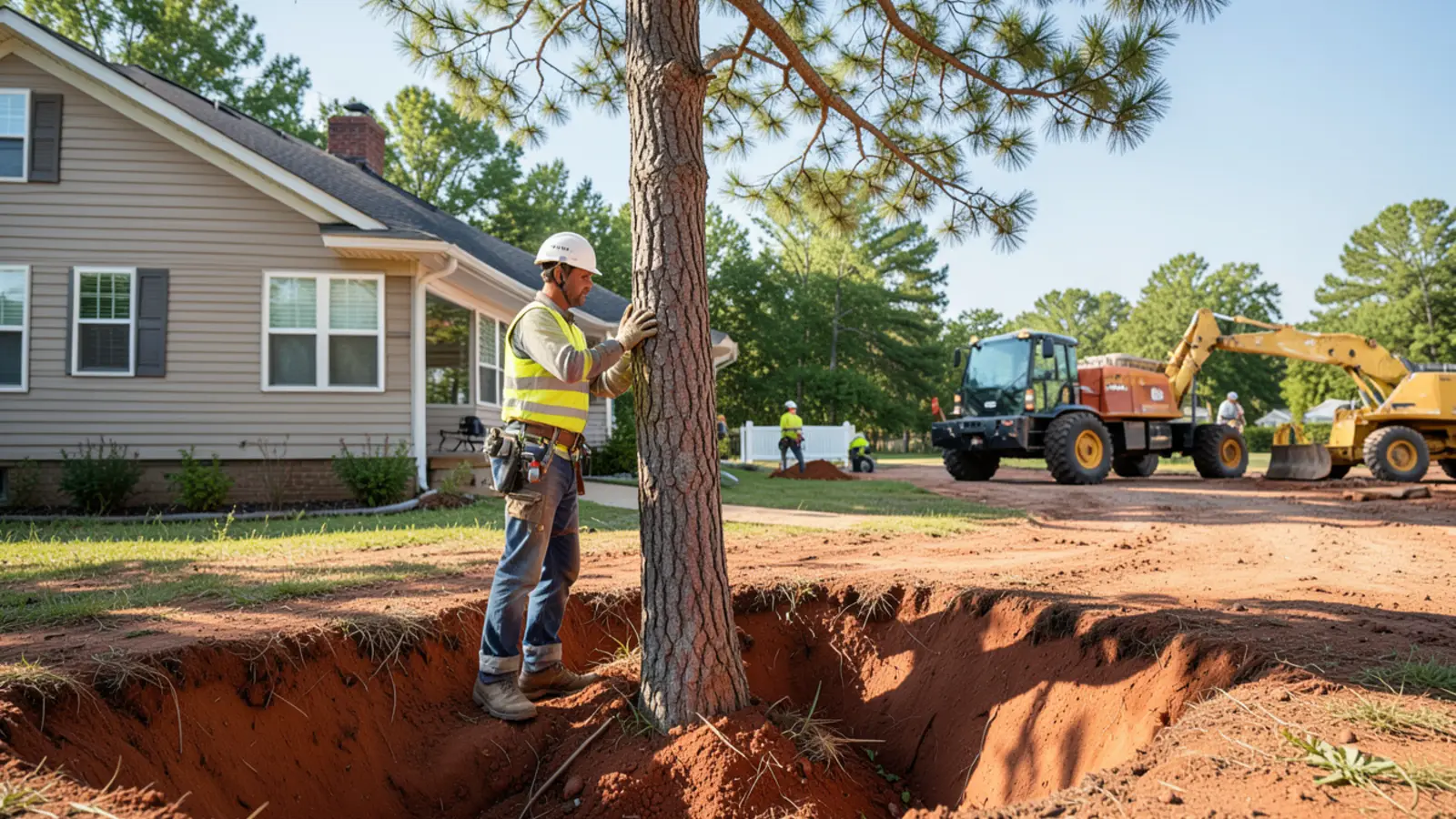
Recognizing early visual warning signs of structural tree failure
Learn how to spot internal decay, root plate lifting, and pine bark beetle damage in West Georgia trees before they fail during severe weather.
Warning Signs in Loblolly Pines: Beetles, Lean & Soil Heave
Loblolly pines (*Pinus taeda*) are the most common tree across Coweta, Fayette, and Carroll counties. Under healthy conditions, they provide towering evergreen shade. However, when stressed by hot, dry summers or construction root damage, pines become highly susceptible to sudden failure.
One of the fastest-killing hazards is the Southern Pine Beetle (*Dendroctonus frontalis*). Female beetles bore into the inner bark, releasing pheromones that attract thousands of beetles. Key warning signs include small white or amber resin 'pitch tubes' resembling popped corn scattered across the lower trunk, reddish-brown sawdust in bark crevices, and needles fading rapidly from green to yellow to rust-red. Once a pine turns rust-red, the structural wood degrades rapidly, creating a severe fall hazard.
Unlike hardwoods that can remain structurally sound for years after partial dieback, dead loblolly pines rot rapidly in Georgia's humid climate. Within 6 to 12 months, wood-boring beetles and sap rot fungi decompose the sapwood, causing the top to snap in modest winds.
In dense pine subdivisions across Newnan and Sharpsburg, look closely for newly developed lean. If a pine leans more than 15 degrees from vertical or displays exposed root flares with cracked red clay soil, the tree has suffered mechanical anchorage failure and must be extracted promptly.
White resin pitch tubes signal southern pine beetle infestation requiring rapid removal
Decay Indicators in Mature Oaks: Conks, Cavities & Co-Dominant Stems
In Newnan's historic neighborhoods and established subdivisions, massive white oaks, post oaks, and water oaks dominate the canopy. While hardwoods can live for over 150 years, internal fungal decay often advances silently behind intact exterior bark.
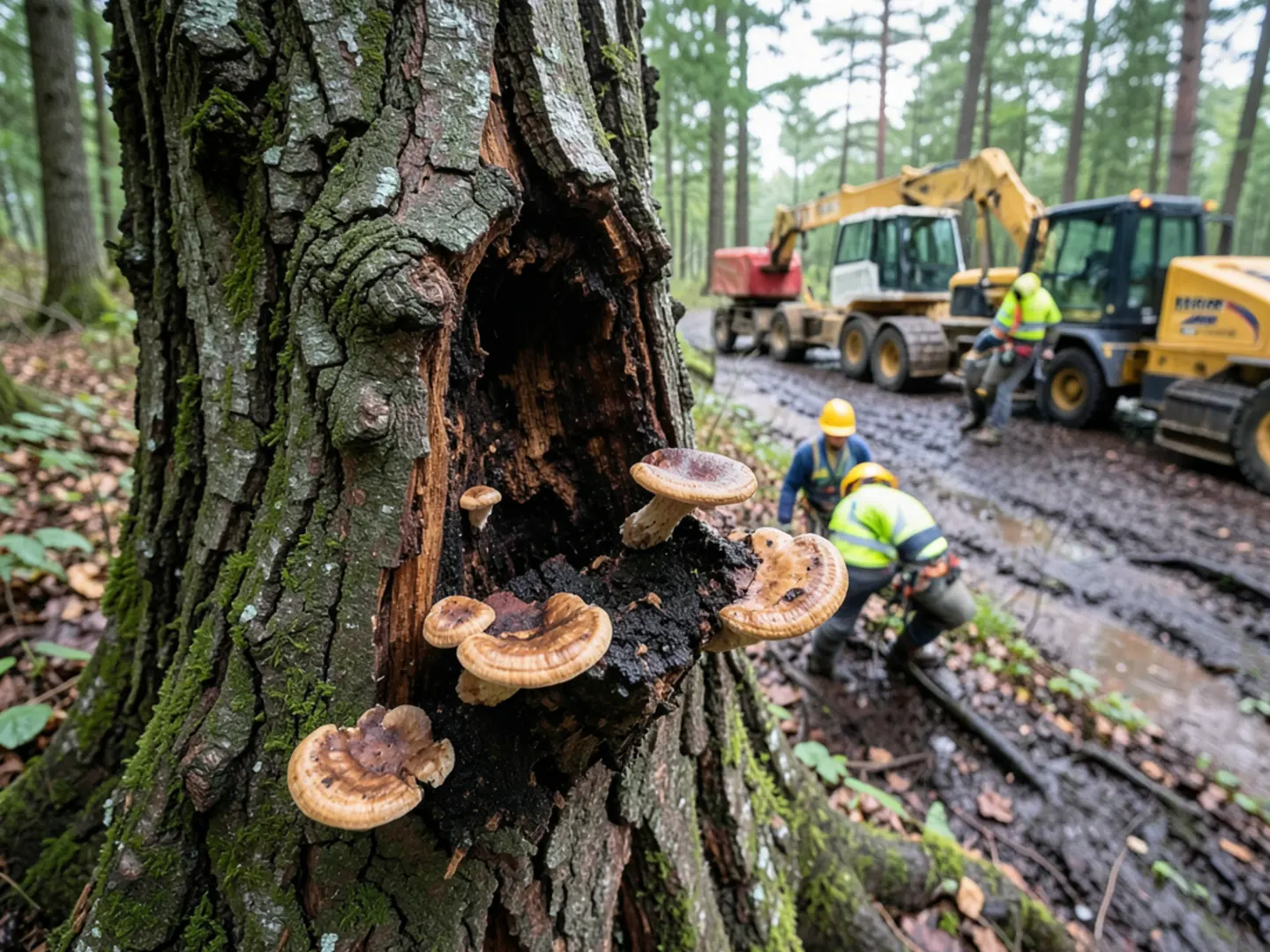
Look closely for fungal fruiting bodies—often called shelf mushrooms, brackets, or conks—sprouting from the root flare or lower trunk. Conks indicate that internal heartwood decay fungi (*Inonotus* or *Ganoderma*) are actively consuming the tree's structural cellulose. Additionally, trees with 'co-dominant stems'—where two large trunks grow from a tight 'V' crotch with included bark—are at extreme risk of splitting down the middle during heavy windstorms.
Deep vertical frost cracks or lightning scars that show blackened margins also warrant immediate inspection. If decay cavities exceed one-third of the trunk diameter, structural integrity is severely compromised.
Our arborists use rubber-headed acoustic sounding hammers to tap the trunk circumference. Sound wood produces a sharp, high-pitched resonance, while internal hollows and decay pockets yield a dull, hollow thud, pinpointing internal structural compromise that is invisible from the outside.
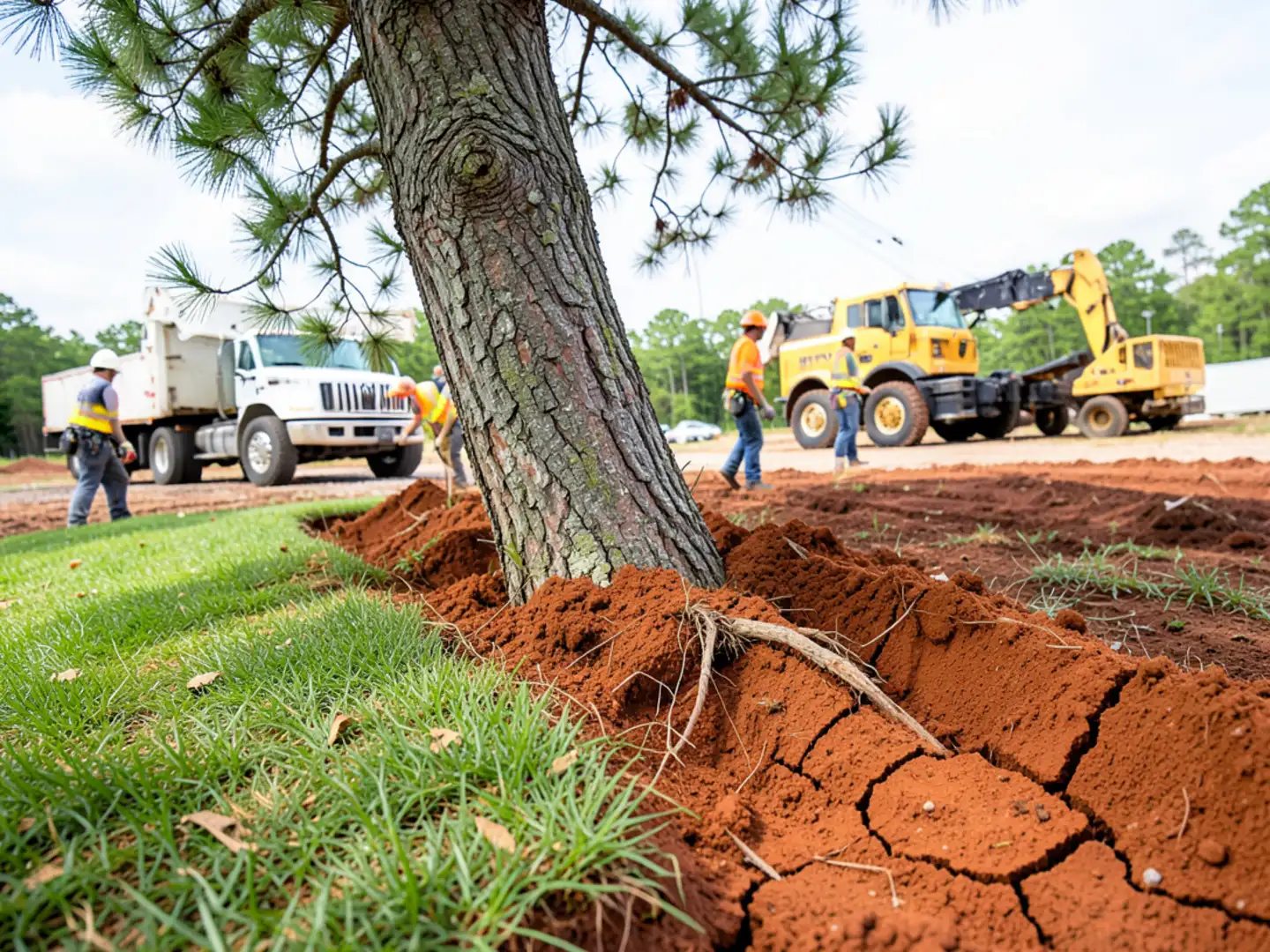
Soil heaving on the opposite side of a lean indicates imminent root plate failure
Get immediate advice and transparent pricing from our Newnan tree specialists.
Tree Defect Risk Matrix: Symptoms, Danger Level & Action
Use this risk assessment matrix to evaluate trees on your property and determine whether emergency removal or preventive pruning is appropriate.
| Visible Tree Symptom | Biological Cause | Risk Level | Recommended Action |
|---|---|---|---|
| Amber pitch tubes & red needles | Southern Pine Beetle attack | Extreme | Immediate complete removal before wood rot |
| Mounded soil / root plate lifting | Structural anchor root failure | Extreme | Emergency extraction; clear target zone |
| Bracket fungi / conks at trunk base | Heartwood decay (*Inonotus*) | High | Sounding inspection & resistance drilling |
| Tight V-crotch with included bark | Co-dominant stem failure risk | High | Install dynamic steel cable or weight reduction |
| Dead branches >2 inches in canopy | Natural senescence or localized rot | Moderate | ANSI A300 deadwooding & crown thinning |
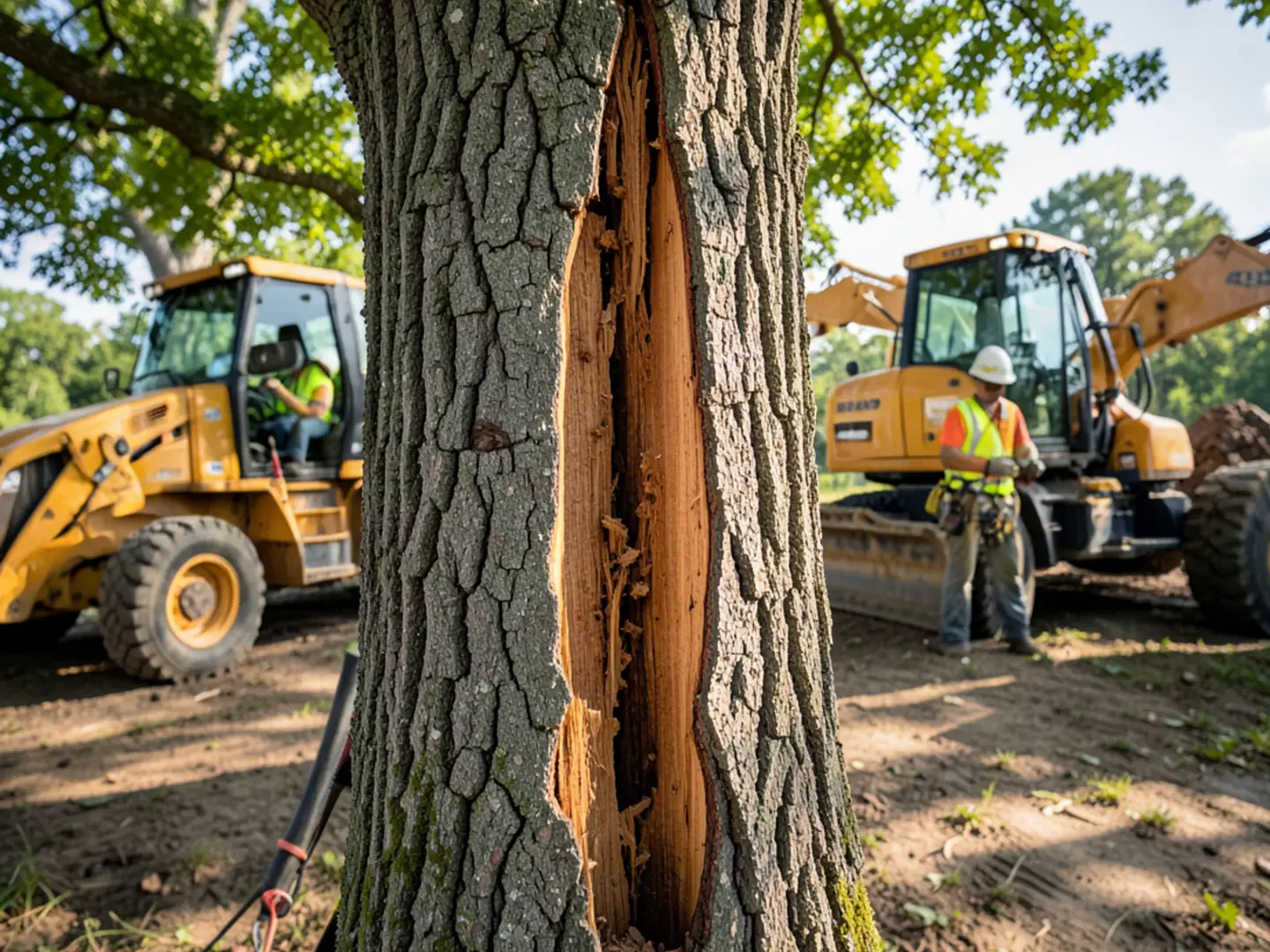
Weak V-crotches with included bark are prone to catastrophic splitting in high winds
How Ground Saturation Weakens Georgia Red Clay Root Anchorages
The interaction between Georgia red clay and heavy rainfall creates distinct root hazards. Because clay particles pack tightly together, rainwater does not drain quickly through subsoil. During multi-day storm events, the root zone becomes supersaturated.
When walking your property, inspect the soil on the side opposite the tree's natural lean. If you see mounded, cracked, or raised soil where turf has lifted, the tree's structural anchor roots have already begun to shear. A tree with active soil heave can tip completely over without warning, even in moderate breezes.
Trees growing along creek embankments or roadside ditches are particularly vulnerable as water erosion scours away supportive soil, exposing root flares to sudden windthrow.
During severe multi-day storm systems like the tropical remnants of Helene, red clay soil transitions from a firm cohesive matrix into a frictionless mud slurry. When saturated clay loses its shear resistance, tall canopy trees experience sudden windthrow even without trunk structural defects.
Evaluating Target Potential Around Buildings, Decks & Play Areas
In arboricultural tree risk assessment, a defect only becomes a hazard if there is a 'target'—a person, structure, vehicle, or utility line within the tree's potential fall path.
When assessing a leaning or decaying tree on your property, calculate the 1.5x height radius. If an 80-foot tree is situated within 120 feet of your master bedroom, children's outdoor play area, detached workshop, or your neighbor's roof, the consequence of failure is catastrophic.
Conversely, a hollow oak standing in an open 5-acre cow pasture with no surrounding targets can often be monitored safely as wildlife habitat rather than removed.
When Can a Tree Be Saved With Structural Pruning or Support?
Not every compromised tree requires immediate removal. If an arborist inspection reveals that internal decay is limited to less than 30% of the trunk cross-section and the root flare is firmly anchored, professional structural pruning can often rebalance the tree and preserve it safely.
Selective crown reduction removes weight from overextended lateral limbs, reducing the rotational leverage exerted on structural forks. In some cases, installing high-strength steel cabling and bracing rods in the upper canopy can provide auxiliary support for heavy co-dominant limbs while retaining shade and aesthetic value.
When Immediate Tree Removal Is the Safest Option
Conversely, when structural defects exceed safe biological limits, removal is the only responsible course of action. If a tree exhibits more than 40% trunk hollow, has dead anchor roots on multiple quadrants, leans heavily toward an occupied bedroom, or is dead and dropping limbs larger than 4 inches, do not wait for the next storm. Contact Honey Bear Tree Service for a prompt evaluation.
In West Georgia, delaying the removal of a known hazardous tree creates severe legal and financial risks. If a dead pine or decaying oak damages a neighbor's property after you were made aware of its defects, Georgia courts can hold the property owner personally liable for negligence rather than classifying the incident as an Act of God. Our tree specialists provide detailed risk evaluations to help homeowners make timely, responsible decisions.
Call (321) 677-9055 to schedule an on-site hazardous tree inspection with our Newnan crew. We provide honest evaluations, itemized written quotes, and safe tree extractions across Coweta, Fayette, and Carroll counties.
Frequently Asked Questions About This Topic
Southern Pine Beetle attacks produce distinct symptoms: small yellowish-white resin blobs (called pitch tubes, resembling popcorn) clustered along the bark crevices of the lower and middle trunk, fine reddish boring dust accumulated in bark furrows and on understory foliage, and rapid canopy discoloration fading from pale green to bronze and rust-red across several weeks.